Coworking management software that runs the whole space for you.
DeskOS is coworking management software for operators of coworking spaces and managed offices. Seats, members, billing with VAT or GST handled, meeting rooms, doors and a member app under your own brand. One system, live in about a week.
- Rated 4.9 / 5 by the operators who run on it
- Operators across India, the Middle East, Europe and South East Asia
- From $59 a month, every module included
- Human support on WhatsApp, 24/7 phone on Enterprise
- ISO/IEC 27001:2022 certified
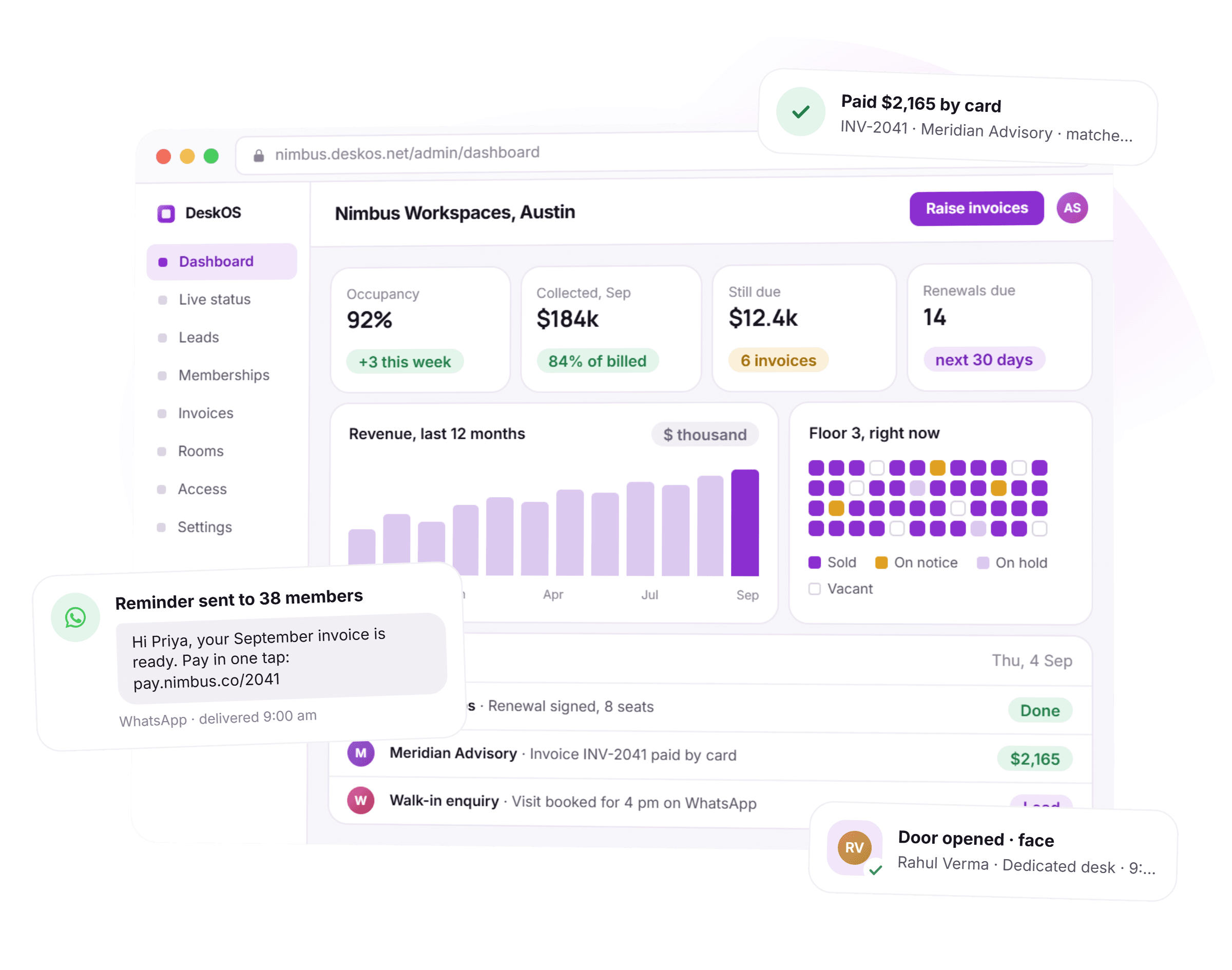
See it on your own floor plan
A free thirty minute demo with a person, not a recording. No card, no commitment.
Security and data protection
- Certificate 26MEQXD44
- EU and UK personal data
- Independently penetration tested
- India DPDP Act 2023
Everything a coworking space runs on, in one place.
Not six tools stitched together. One system where the seat, the member, the invoice and the door all know about each other.
- Floor 241 of 48 soldSoldOn noticeOn holdVacant
Seats and occupancy
Every desk, cabin and office across every location, live. Sold, on notice, on hold, vacant.
Space management - Kestrel Labs8 seats · renews 1 OctRenewalSana IqbalFlexi · paidActiveBrightpath Design12 seats · notice givenOn notice
Members and companies
One record per company: people, seats, plan, agreement, invoices and who has a door card.
Members and engagement - Tax invoice · INV-2041Sep 20264 dedicated desks$1,800Sales tax 8.25%$149Total$1,949Paid · Card
Billing and collections
Invoices raised for you every cycle, VAT or GST worked out per invoice, payments matched back by themselves.
Billing and payments - Boardroom · today8 seats910111212345Priya S. · 4 to 5 pm2 credits · 6 left
Meeting rooms
Members book from the app, credits come off, overages land on the next invoice.
Meeting room management - WelcomeRahul V.FaceVisitor · Dev P.QR passVikram R.Ended 31 Aug
Doors and visitors
Access on the same record as the membership. Cancel a plan and the door knows.
Access control and visitors - Good morningPriyaDesk 3-14 · ActiveBoardroom · 4 pm$540 · Pay by cardyour
coloursYour own member app
Your name and icon on both stores. Bookings, invoices, visitors and the door, in their pocket.
Everything in the platform
Thirty minutes with a person, on your own floor plan.
Ninety seconds on what DeskOS actually does
A day at your space, with the admin done.
Six things that used to take a person, and what they look like when the system does them. Shown in dollars; DeskOS bills in your currency.
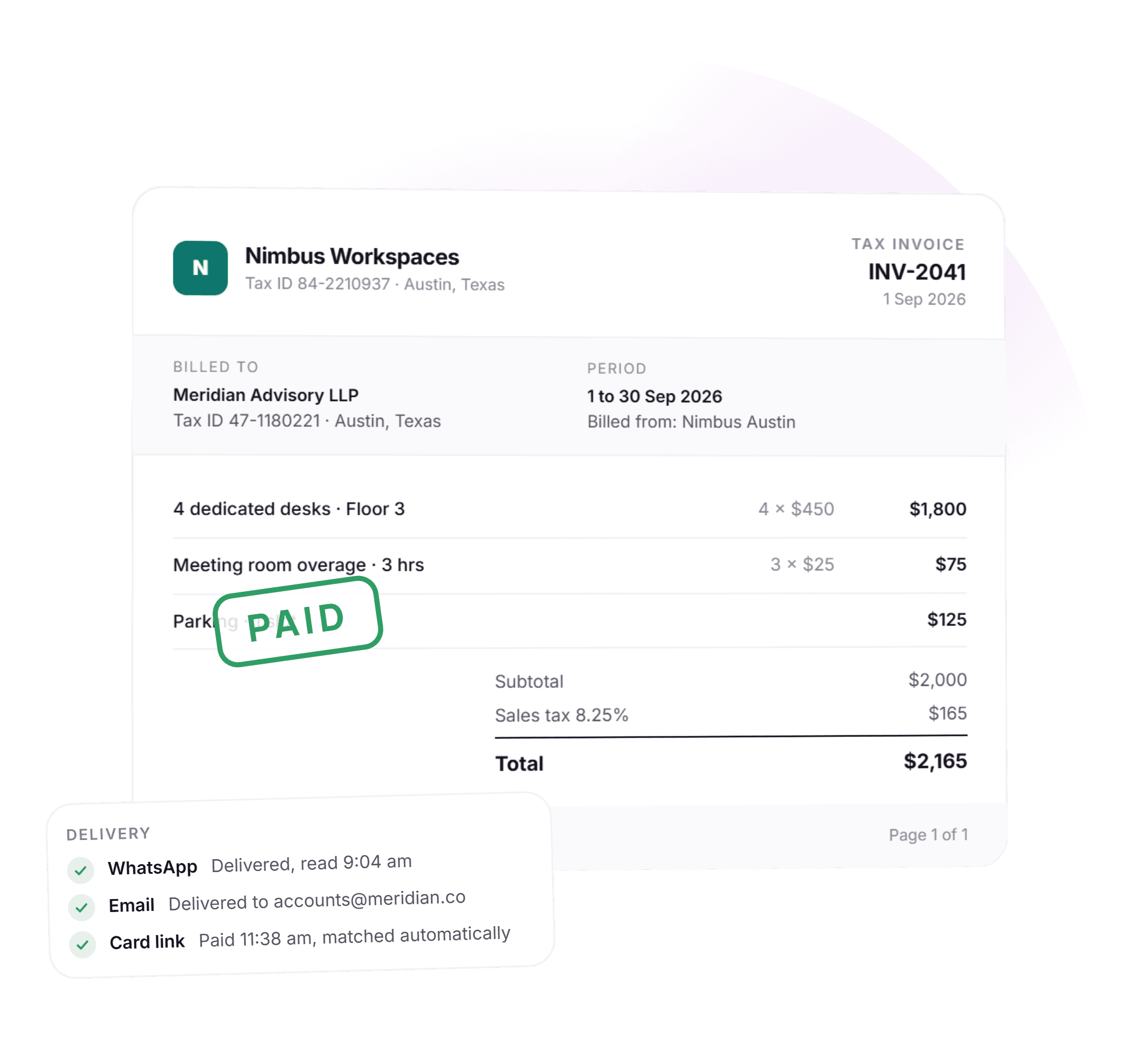
The first of the month stops being a day.
Every subscription raises its own invoice on its own cycle, with VAT or GST on every line. Each one goes out on WhatsApp and email with a payment link, and money that comes back by card or bank transfer is matched to the invoice without anyone opening a bank statement.
- Invoices for the whole month raised in one click
- Payment links on every invoice, receipts sent by themselves
- Reminders before the due date and after it, on WhatsApp and email
- Pushed to QuickBooks, Xero, Zoho Books or Tally
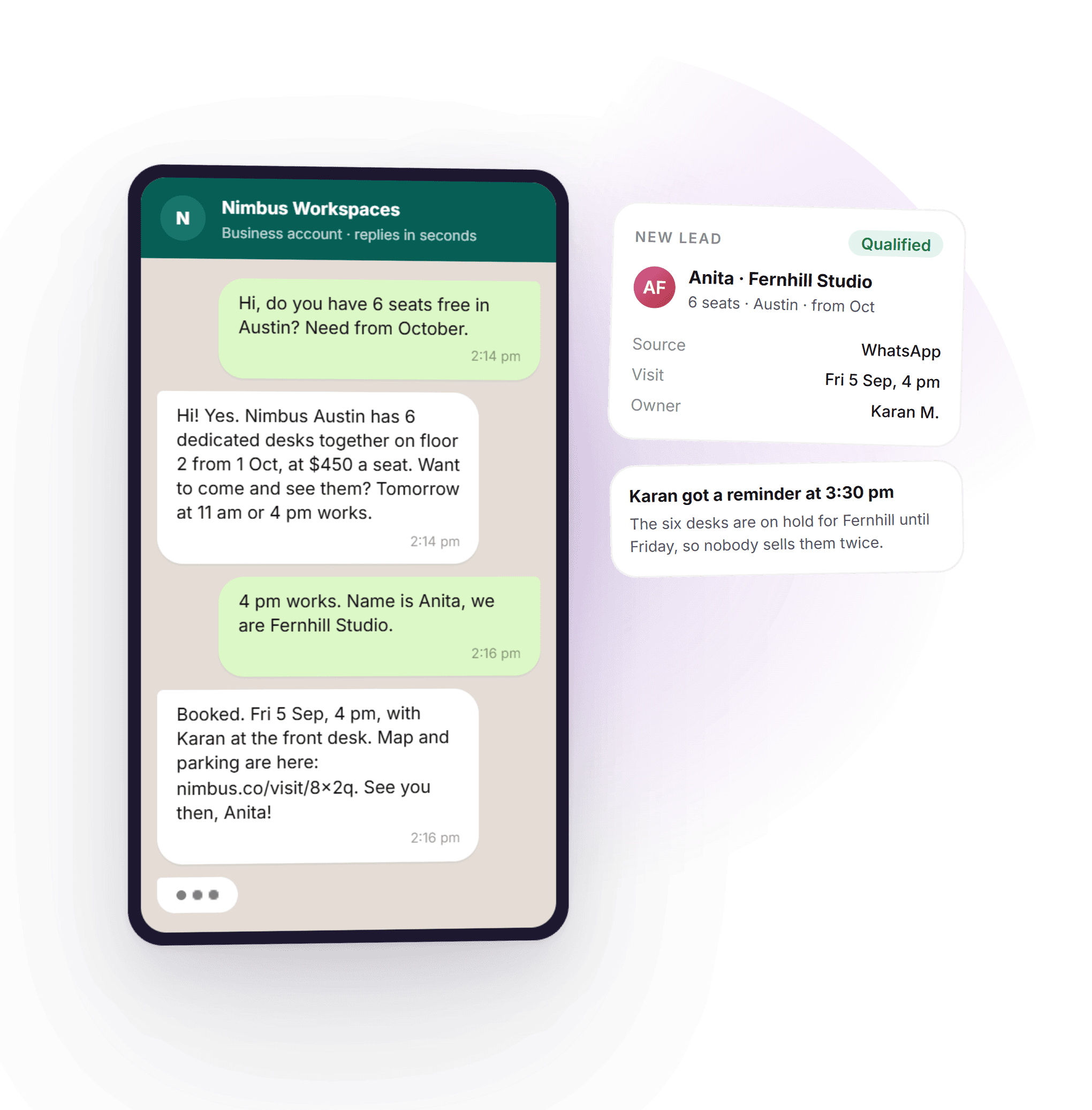
Enquiries answered at 11pm, by nobody.
A lead lands from your website, WhatsApp or a listing site, gets a reply, gets qualified and gets a visit booked while your team is asleep. When they say yes, the agreement is drafted from the plan, signed on a phone and filed against the company record.
- Every enquiry in one pipeline, whichever channel it came from
- Follow ups sent on schedule until someone books a visit
- Proposals and agreements generated from the plan, e-signed, countersigned
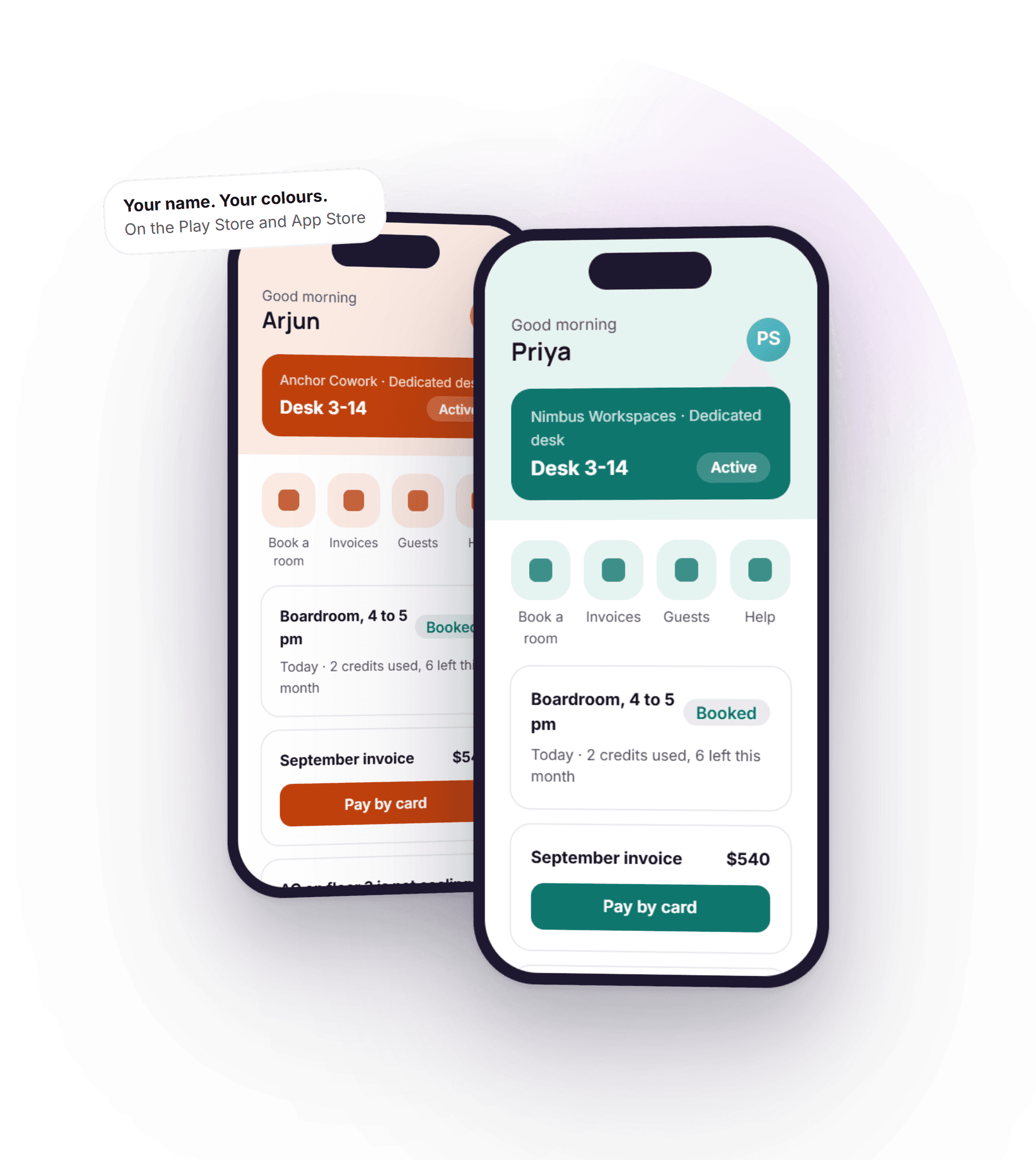
Your brand on both stores.
Members book rooms, see invoices, pay, register visitors and open the door from an app with your name and icon on it. We publish it under your developer account, you never touch a build.
- iOS and Android, under your name
- Room booking, invoices, visitors, tickets, community
- The same app works across every location you run
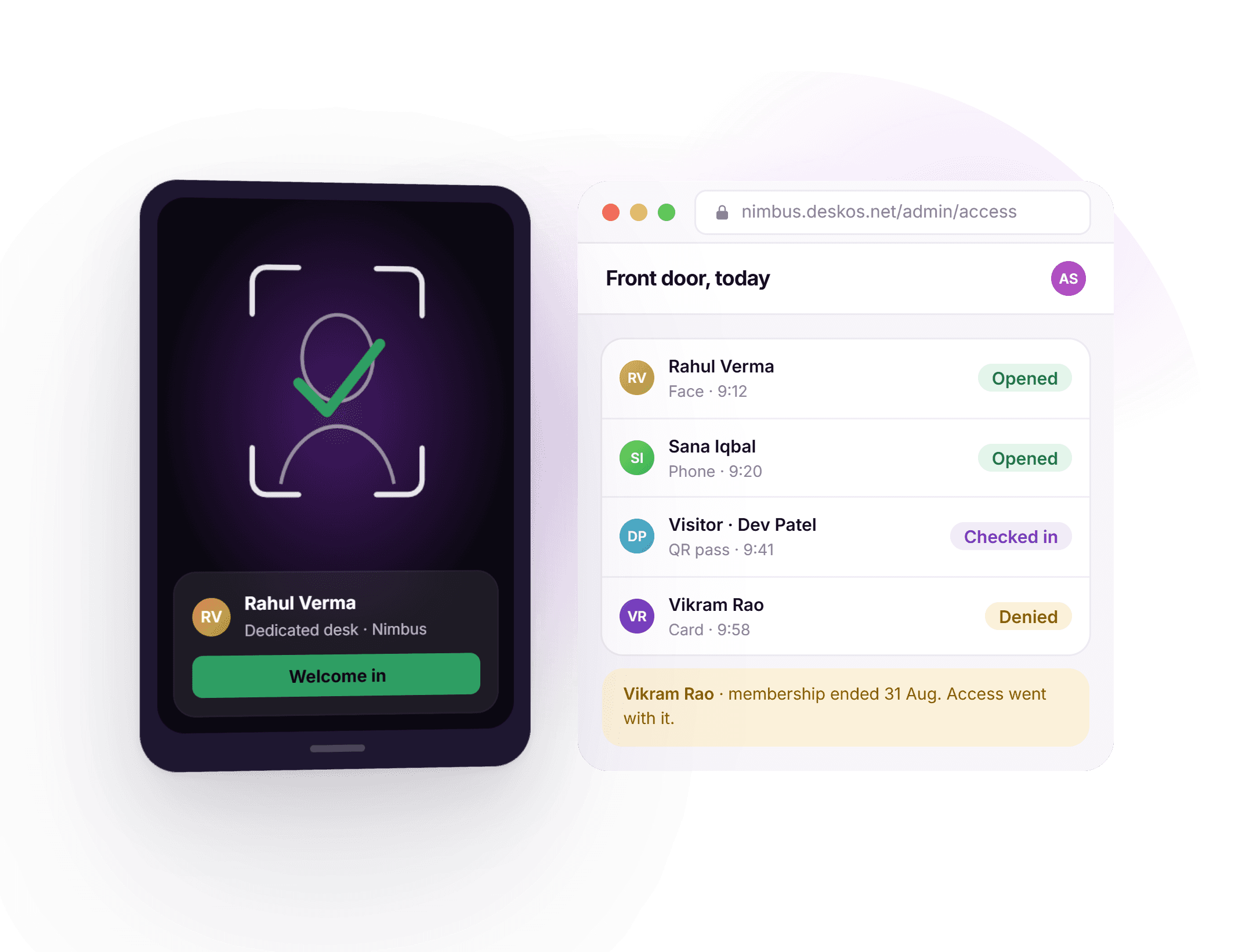
The door reads the membership.
DeskOS talks to the biometric readers and smart locks you already have. A new member gets access the moment they are activated, a lapsed one loses it the moment they are not, and every entry lands in one log.
- ZKTeco, Spintly, Kisi and more, no forklift
- Access follows the plan: cancel it and the door knows
- Every entry logged against the member, per location
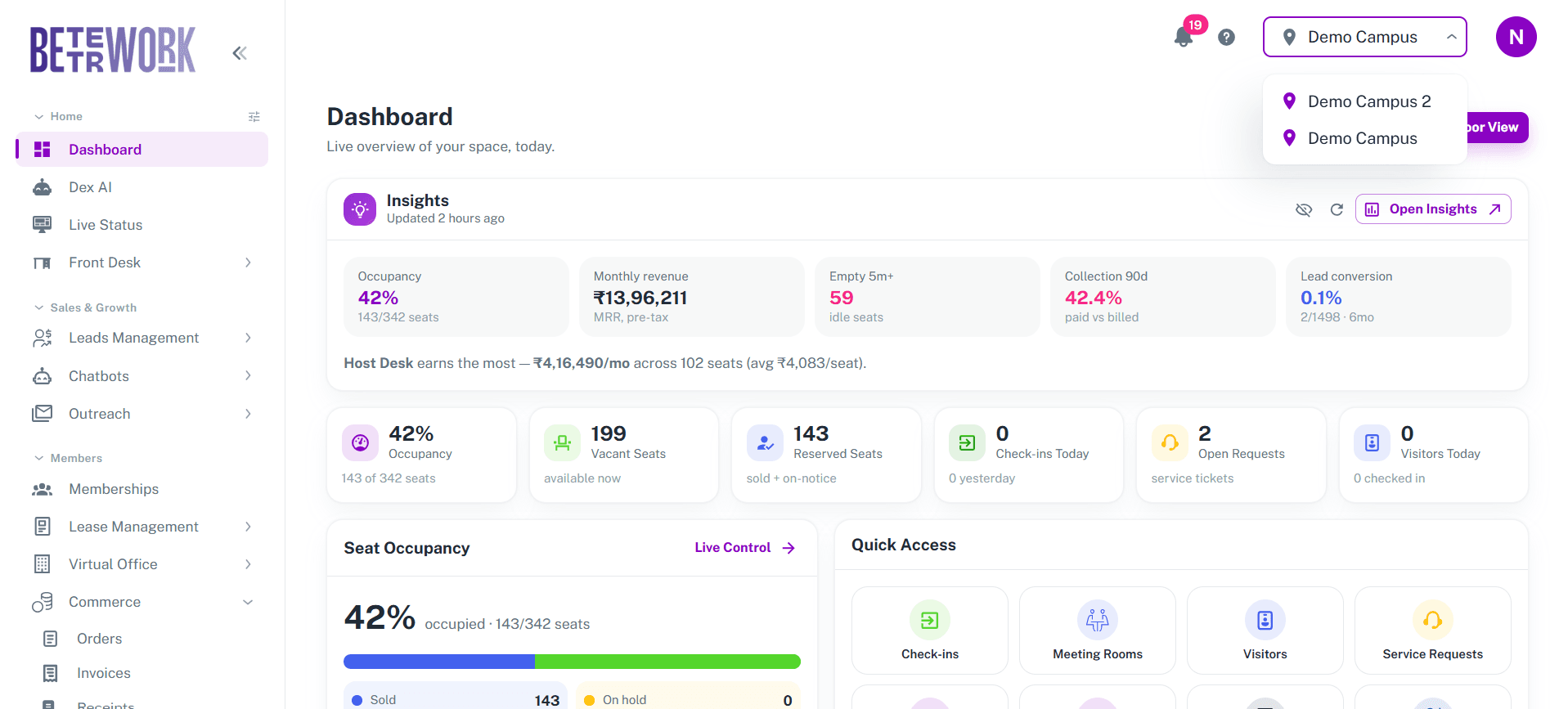
Every location on one screen.
Occupancy, collections, dues, renewals and churn for each location and for all of them together, live from the same records that raise the invoices. No export, no month-end spreadsheet.
- Switch between locations or see the whole portfolio
- Occupancy that counts seats the same way finance does
- Renewals due and members on notice, weeks ahead
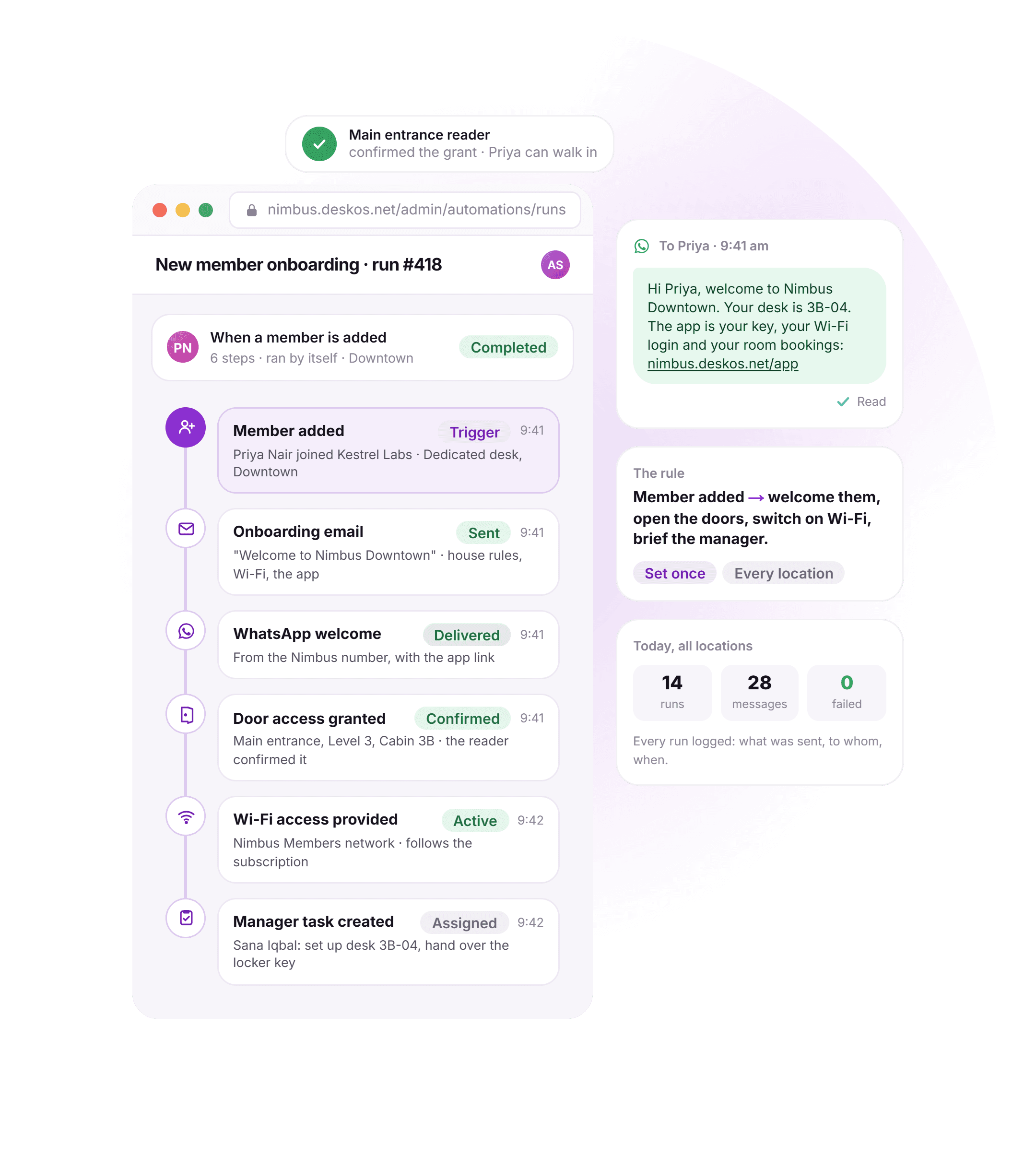
The chasing does itself.
Build the rules once: remind three days before an invoice is due, welcome a new member, nudge a lead who went quiet, alert you when occupancy dips. DeskOS runs them every day without being asked.
- Triggers on anything that happens in the system
- Messages on WhatsApp, email and in the app
- Every run logged, so you can see what was sent and when
See it running on your seats, your plans and your billing.
Works with what you already use











“DeskOS has been really valuable for us. The visibility helps us make better decisions, while the automation has taken a lot of manual work off our plate.”
Sanjeev Laroia, Spacetime · 3,000+ seats across India
700 invoices in a single click
A full month raised in one action, GST worked out per invoice, and every one delivered on WhatsApp and email the same day.
100 leads a day, nobody typing
Enquiries land, get qualified by workflow and are sent an invitation to come and see the space, without anyone opening a sheet.
Meeting rooms stop being your problem
Members book from the app, credits come off automatically, overages land on the next invoice, and the front desk keeps no diary.
ISO/IEC 27001:2022 certified
Built for enterprises that run a proper security review. Our certificate, penetration test report and disaster recovery report are ready for your IT and procurement teams.
Certificate 26MEQXD44
What changes when the pieces talk to each other.
Spreadsheets and separate tools both work, right up to the month they cost you a member. This is what the difference looks like day to day.
- One record per member
- Spreadsheets
- A row in a sheet, copied into the invoice tool by hand
- Separate tools
- A CRM, a billing tool and a door system that each keep their own
- DeskOS
- The seat, the invoice, the agreement and the door on one record
- Tax on every invoice
- Spreadsheets
- Worked out by hand, corrected at month end
- Separate tools
- Depends on the invoicing tool and how it was set up
- DeskOS
- Correct VAT or GST on every invoice, per billing entity
- Getting paid
- Spreadsheets
- Chase, check the bank, mark it paid
- Separate tools
- Payment gateway bolted onto the invoice tool
- DeskOS
- Payment links on every invoice, card or bank transfer, matched back by themselves
- WhatsApp and email
- Spreadsheets
- From your own phone, whenever you remember
- Separate tools
- A separate messaging tool with its own contact list
- DeskOS
- Invoices, reminders, visitor passes and lead replies from the system
- Member app
- Spreadsheets
- None
- Separate tools
- Someone else’s brand, or a web link
- DeskOS
- Your brand on both stores, published by us
- Support
- Spreadsheets
- You
- Separate tools
- A ticket queue per vendor
- DeskOS
- One team, on your hours, on WhatsApp
- Price
- Spreadsheets
- Free, until the month it costs you a member
- Separate tools
- Four subscriptions
- DeskOS
- From $59 a month, no per module add-ons
Bring your seat count and your billing headaches.
Simple plans. No per module add-ons.
Basic starts at $59 a month billed yearly, excluding VAT or GST. Every plan includes every module. You pay for seats and locations, nothing else.
Basic
For smaller spaces streamlining operations and getting billing under control.
$59 / month
billed yearly
- Active seats
- Up to 100
- Locations
- 1
Includes
- Space management and utilisation
- Meeting room management
- Billing with automated invoicing
- Helpdesk and service requests
- Web based access for the team
- Most taken
Business
Growing spaces building a community and premiumising what they sell.
Quoted on request
Scoped to your seats and locations
- Active seats
- Up to 200
- Locations
- 2
Everything in Basic, plus
- Visitor management
- Daily check-in management
- Community management
- Leads management CRM
- Payment gateway, receipts and credit notes
- Dedicated relationship manager
Business+
Bigger spaces that want their own apps and their own brand in front of members.
Quoted on request
Scoped to your seats and locations
- Active seats
- Up to 600
- Locations
- 3
Everything in Business, plus
- Whitelabel Android and iOS apps
- Lease management
- Client attendance tracking
- Cafe management
- Advanced reports
- Priority support, 24x7
Running more than three locations or 600 seats? That is Enterprise, quoted once we know your portfolio.
Still tied into another platform? We will buy out your contract. Ask us on the call.
Real people, on your hours.
DeskOS is built and supported from offices in New Delhi and Delaware. Support runs on your working hours, on WhatsApp, and the person who sets you up is the person who answers when you call.
What happens next
- 1
You fill in the form
Or message us on WhatsApp. Either way a person replies, usually the same working day.
- 2
We show you DeskOS on your own floor plan
A thirty minute call, in your time zone. Your seats, your plans, your billing.
- 3
You are live in about a week
We import members, seats and open invoices. You never run the old tools alongside it.
Questions operators ask us
We are outside India. Does DeskOS work for us?
Yes. Operators run DeskOS across India, the Middle East, Europe and South East Asia. Currency, tax and invoice format are set per billing entity, so a company with locations in two countries bills each one correctly from the same account. Payments go through Razorpay or Stripe depending on where you are.
We run more than one location. Is that one account or several?
One account. Every location has its own seats, plans, rooms and doors, and you switch between them or see the whole portfolio on one dashboard. Members can be given access across locations if you want that. Billing can run from one legal entity or several.
Is the member app really under our brand?
Yes. Your name, your icon, your colours, published to the App Store and Google Play under your developer account. We build and submit it; you approve it. It is included on Business+ and Enterprise.
How long does it take to go live?
About a week for a single location, a little longer for a portfolio. We import your members, seats, plans and open invoices, connect your payment gateway and your doors, and train your team. You stop using the old tools the day you switch.
Can we keep our biometric readers and smart locks?
Almost always. DeskOS works with ZKTeco and other ADMS readers, Spintly, Kisi and several more. Tell us what is on your doors and we will confirm before you sign anything.
Does it work with our accounting software?
Invoices and payments push to QuickBooks, Xero and Zoho Books, and export to Tally. Your accountant keeps working where they already work.
What does it cost?
Basic starts at ₹7,999, $59 or €59 a month billed yearly, excluding tax, for up to 100 seats at one location. Business and Business+ add locations, seats and the member app. Every plan includes every module; there are no per module add-ons. Setup and training is optional and one-time. Full pricing is on the pricing page.
See DeskOS on your own floor plan.
Thirty minutes with a person who has set up spaces like yours. Bring your seat count and your billing headaches.